Thursday, June 07, 2012

Book Notes: Non-Fiction

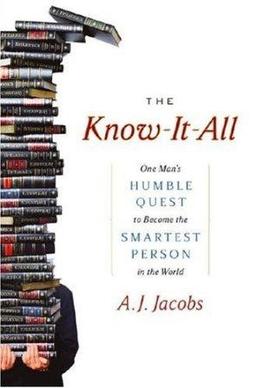
The Know-It All felt like a drag. I really enjoyed Jacobs' other book A Year of Living Biblically, but this one just didn't hold my interest the same way.

Jacobs takes on reading the entire Encyclopaedia Britannica, as a way of completing a goal his intellectual father had but never finished. He comes across as an insecure, whiny, privileged upper middle class person who is embroiled in petty neuroses - often obsessing over people's approval and recognition of his intelligence.

Which is why he begins to foist his new-found facts on anyone and everyone, at any possible opening in the conversation.

The chapters are broken up into letters, and the facts he pulls out of the Britannica are organized alphabetically and he often intersects them with his past or present experience. So it becomes a memoir as well.

I took a break partway through to read other things for a while.

But I'm being a little harsh. It does get better, and the facts he pulls out are often quite interesting. By the end he seems to have also picked up a modicum of social awareness and some wisdom and perspective on history/life. So I was okay with it. But his other one (perhaps too because it's his second) was better. I'm on the waiting list for his newest book (where he tries all kinds of crazy health fads in a quest to become the healthiest person) so we'll see what I think of that!


Wheat Belly by William Davis was one of the books I got distracted by. His premise is that wheat has been mucked with so much in the past 50-ish years (to up the yield, etc.) that it is no longer the same plant our ancestors ate. And it is now harmful to our health - as addictive as heroin (binds to the same receptors), spikes your blood sugar levels higher than the same amount of table sugar (causing insulin spikes), and causes many, many other health problems. And apparently most of us don't digest it well, whether we know it or not. He claims that wheat makes us fat, tired, and causes inflammation and diabetes.

I've decided to give it a chance and have been wheat-free for almost a week. My stomach has been happy so far. I'd like to try being off it for a month or so and then reintroduce and see if I feel any negative effects. I haven't been hyper-vigilant about gluten popping up in other places - I haven't checked my toothpaste or looked for certified gluten-free oats (they're often processed in the same place as wheat). Maybe I'll eventually check out those products - we'll see.


Bringing up Bébé was another of my sidetrack reads. I found a good summary of it on another blog (why write my own when someone else has done it better?)

While the author's moral fibre may be questionable - she's written an article about how it's helpful to allow cheating and group sex in your marriage - the book had some excellent insights into the difference between N.American and Parisian parenting styles.

It's a little early for me to start reading parenting books (nope, nothing to announce). But I do want to be a parent eventually, and I was genuinely interested in the philosophical differences between French and American parenting. There are pieces of French parenting that made a lot of plain old common sense, specifically: establishing very strong boundaries but allowing freedom of choice within those, encouraging independent exploration/play, establishing strong rhythms of eating and sleeping, and teaching your child to wait, respect other adults, and respect your authority.

Saturday, June 02, 2012

Book Notes: Hotel on the Corner of Bitter and Sweet

What a beautiful novel this was.

When it started I wasn't sure whether I would like it or where it was going, but as it got going I was hooked.

Jamie Ford paints a human and compelling picture of relationships: between the US and its Japanese-American citizens during WWII, between an emotionally distant Chinese father and his son, between this son and his own son, between the Japanese and Chinese communities in Seattle in the 40's, between two young people who have their first inklings of the deep friendship and respect that is love.

I loved the portrait of these complex relationships at the time. He managed to get them just right -  a few words, little sketches that promoted my understanding of different people's points of view without going into slogging detail.

Henry is our protagonist. Born on American soil, the only student of Chinese descent in his private English school (where he is bullied and miserable), not allowed to speak Mandarin to his parents as they want him to focus solely on his English (but they don't understand or speak much English, which makes for little communication), forced to wear a "I am Chinese" pin to school by his father (so he is not targeted as Japanese).

With all these conflicting influences, it's no wonder he rebels. His only friend is a black jazz sax player who busks on the street corner, until a Japanese-American girl named Keiko comes to his school. As they share school chores together (they clean the classrooms and serve lunch), their friendship grows.

Even after the Japanese are taken away to internment camps they continue their relationship. But eventually they lose touch. She stops writing. He gets engaged to a very sweet Chinese girl, and loves her, has a son with her, and cares for through her cancer until her death.

I loved this portrayal of love. It was bittersweet. It felt real. He did genuinely love his childhood sweetheart, but when she stops writing, he starts seeing and eventually commits himself to another. Once he's made this commitment, he honors it. There is love and happiness in his commitment, even though it was not his first choice.
A message we need to hear more often, I think.

Friday, May 25, 2012

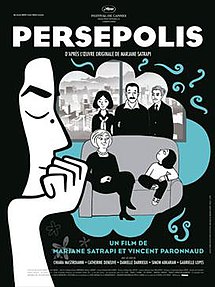
Book Notes: Persepolis

I've read a few graphic novels lately:

Persepolis, written by an Iranian-Parisian about her childhood in Iran to moderate, modern parents in an increasingly extremist society. Early in her childhood she is relatively free, but as regimes change and a war with Iraq breaks out, the more fundamentalist groups of Islam gain traction. As she grows up, they have to be more and more careful - wearing veils and proper clothing, what they say and how they act in public - hiding their alcohol and hosting parties with the blinds carefully closed.

Her parents eventually send her to Austria to finish school in more freedom, but she doesn't totally fit in there and she doesn't fit in when she gets back. After a time back in Iran, a failed marriage, and the increasing frustrations of being an artist in a restrictive society, she leaves for Paris, where the story ends.

I found the book interesting, and liked the strong, stubborn, and curious main character. She was interested in revolutionaries at the age I was still reading Narnia. She had cultural insights that I appreciated, and gave a brief overview of her country's history, which I found accessible. I liked the visual of the book - all black and white. The only thing I didn't like was the angst accompanied much of her journey. Her highs and lows were understandable for such a strong personality in such a confining and confusing world, but I found it a little off putting.

Something that jumped out at me: when she came back from Austria, she felt the divide between her and her college friends. They tried to resist the restrictions on their appearance in tiny ways - wearing subtle make-up, a hemline that showed their ankle, headcoverings that revealed a bit of hair. She thought it was partly just a game to keep women so caught up in their appearance that they no longer focused on the injustice of the many other, more serious restrictions of their freedom.

It was an interesting insight. However, perhaps in a restrictive regime, any act against it is a way to assert your individuality. But I'd agree that keeping people's attention on the petty is a good way to blind them to the larger problems.

But, I'd argue that almost everyone does that as a coping/ignoring mechanism anyway. How often do couples with issues ignore the root problems and then blow up about who should do the dishes?

Wednesday, May 23, 2012

The song I've had cycling through my head all day...

This morning I just had to stop everything I was doing and let these lyrics sink in.

"Oh My God" - Jars of Clay
Oh my God, look around this place
Your fingers reach around the bone
You set the break and set the tone
Flights of grace, and future falls
In present pain
All fools say, "Oh my God"

Oh my God, Why are we so afraid?
We make it worse when we don't bleed
There is no cure for our disease
Turn a phrase, and rise again
Or fake your death and only tell your closest friend
Oh my God.

Oh my God, can I complain?
You take away my firm belief and graft my soul upon your grief
Weddings, boats and alibis
All drift away, and a mother cries

Liars and fools; sons and failures
Thieves will always say
Lost and found; ailing wanderers
Healers always say
Whores and angels; men with problems
Leavers always say
Broken hearted; separated
Orphans always say
War creators; racial haters
Preachers always say
Distant fathers; fallen warriors
Givers always say
Pilgrim saints; lonely widows
Users always say
Fearful mothers; watchful doubters
Saviors always say:

Sometimes I cannot forgive
These days mercy cuts so deep
If the world was how it should be, maybe I could get some sleep
While I lay, I dream we're better,
Scales were gone and faces light
When we wake, we hate our brother
We still move to hurt each other
Sometimes I can close my eyes,
And all the fear that keeps me silent falls below my heavy breathing,
What makes me so badly bent?
We all have a chance to murder
We all feel the need for wonder
We still want to be reminded that the pain is worth the thunder

Sometimes when I lose my grip, I wonder what to make of heaven
All the times I thought to reach up
All the times I had to give
Babies underneath their beds
Hospitals that cannot treat all the wounds that money causes,
All the comforts of cathedrals
All the cries of thirsty children - this is our inheritance
All the rage of watching mothers - this is our greatest offense

Oh my God
Oh my God
Oh my God

Saturday, May 19, 2012

Musings

I was just reflecting on my new-found desire to blog.

I think that it's partly related to my work, and partly to my renewed escapist obsession interest in reading. I don't have a lot of creative output available to me at work right now, and all these new books are a creative input, needing an outlet.
Though, I suppose talking about other people's creativity doesn't require much creativity - it is easier to be a critic than a creator.

I also don't have energy for much social interaction - haven't been reaching out to people
much lately. Big groups wear me out, church gatherings feel like too many people. Once I'm there, I'm usually okay-ish, but the idea of it is exhausting.
Not to say I've been a total recluse, but beyond visiting our families each week, I haven't wanted to do much. Having one kindred spirit over for a meal and a low-key evening has been almost the only interaction I've been interested in. I should reach out more, I know.

So I guess this is my non-social way of being social, my non-creative way of being creative...